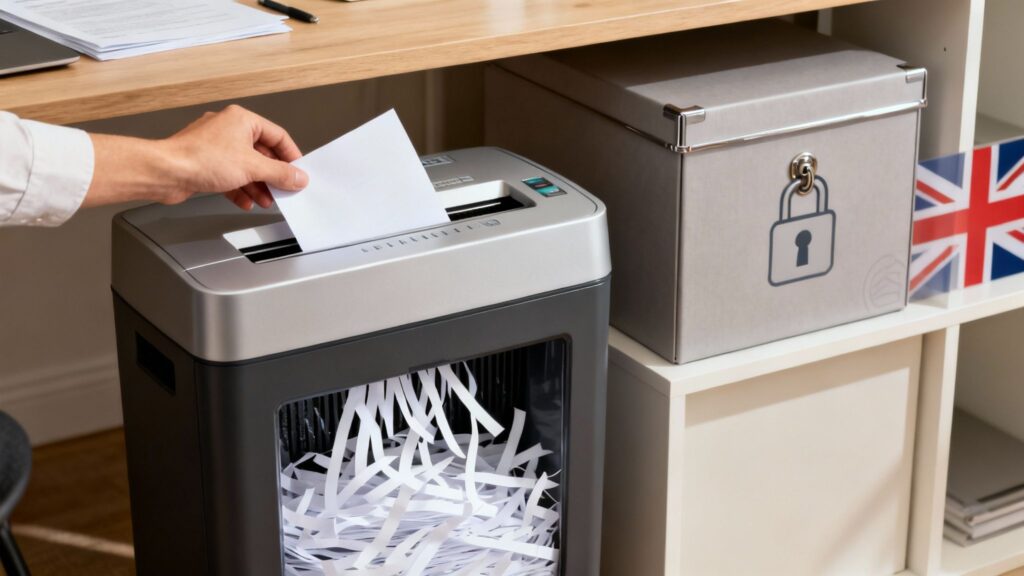
In a world awash with data, the humble act of shredding documents has become a critical part of data protection. This isn't just about keeping your personal details out of the wrong hands; it's a legal requirement under strict UK regulations like the Data Protection Act 2018 and GDPR, affecting everyone from households to multinational corporations.
Why Secure Document Shredding Is Essential for UK Compliance
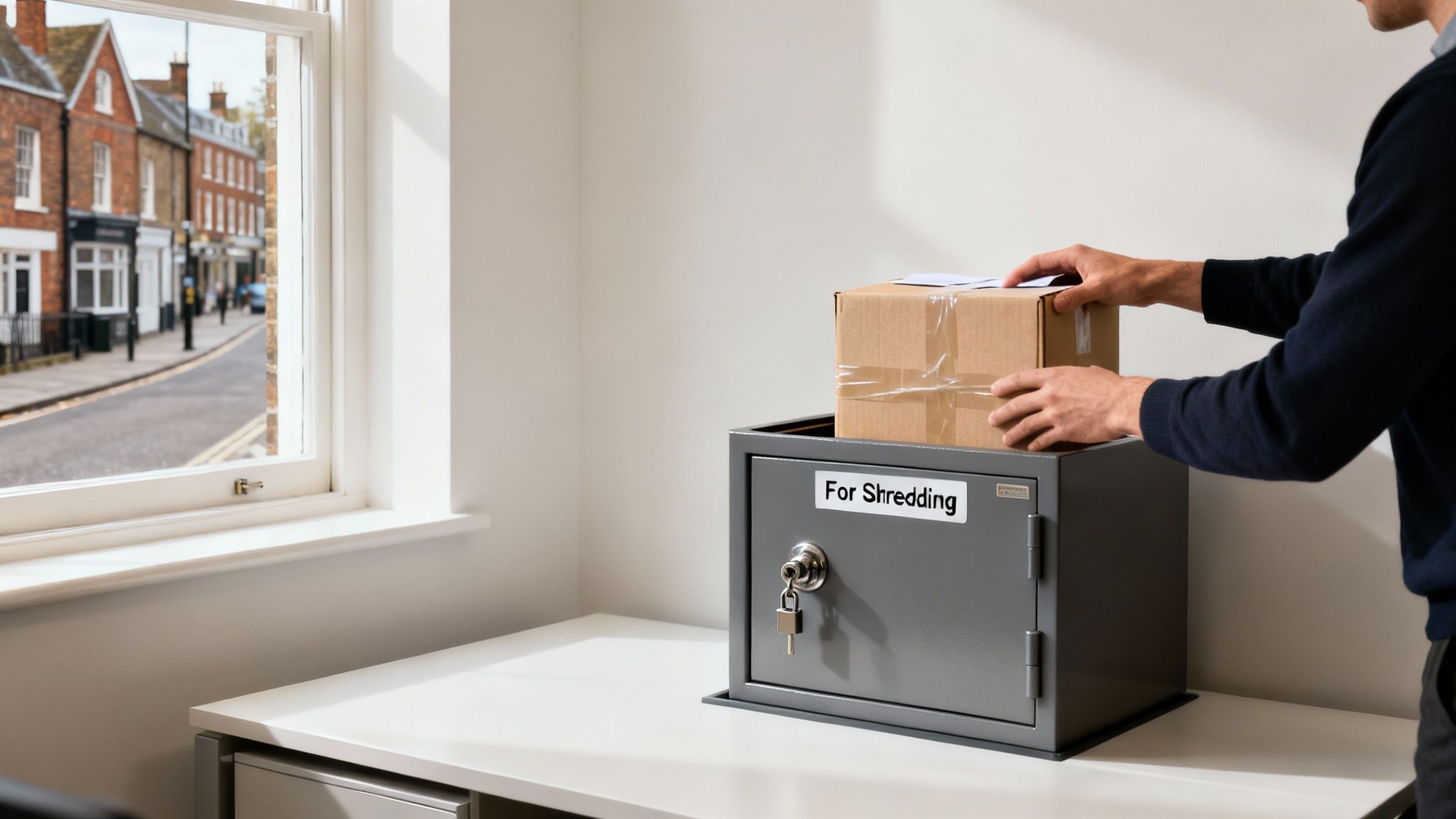
Securely disposing of paperwork is far more than a simple tidying exercise—it’s the final, crucial step in any document’s lifecycle. Think about it: payslips, bank statements, client files, employee records. Every single piece of paper with personal information on it is a potential risk.
If these documents aren't destroyed correctly, the consequences can be severe. For individuals, it's the nightmare of identity fraud. For businesses, the stakes are far higher, with the threat of fines for non-compliance running into millions of pounds.
The Driving Force of Regulation
The UK's regulatory landscape has made a solid disposal strategy absolutely essential. GDPR’s arrival in 2018 was a watershed moment. Document destruction services saw a massive spike that year as businesses scrambled to meet the stricter rules on holding onto personal data. This cemented shredding as a routine, non-negotiable part of modern data management.
A casual approach just doesn't cut it anymore. Key compliance principles you need to follow include:
- Data Minimisation: Only holding onto data for as long as you genuinely need it.
- Secure Processing: Actively protecting personal data from unauthorised access or destruction.
- Accountability: Being able to prove you’re compliant with clear processes and records.
Beyond the Bin Bag
To meet these tough data protection standards, many businesses now turn to professional data security shredding services. It’s the only way to guarantee disposal is handled correctly, complete with a verifiable audit trail for your records.
The rule of thumb is simple: if a document contains information you wouldn't want to see on the front page of a newspaper, it needs secure destruction. This is just as true whether you’re clearing out a home office in the Wirral or managing a huge corporate archive.
Of course, proper document management begins long before the shredder comes into play. For businesses juggling large volumes of paperwork that are earmarked for destruction, keeping them secure in the meantime is vital. Using dedicated storage units for offices provides a safe, interim space to manage archives, ensuring you stay compliant from the moment a document is created to its final disposal.
What to Shred and How Long to Keep It: A Practical UK Checklist
Feeling buried under a mountain of paperwork? It’s a familiar story. But figuring out what to shred versus what to keep can feel like navigating a minefield. The truth is, different documents have different lifecycles, and in the UK, these are often dictated by legal requirements and simple common sense.
Get it wrong, and you could shred something vital far too soon. On the other hand, holding onto sensitive data for longer than necessary is a security risk you don’t need. This isn't about guesswork; it's about putting a clear, organised system in place.
A great way to start is by splitting your documents into three piles: personal, tax-related, and business. Each category has its own set of retention rules, which will tell you exactly when it's time for the shredder. A receipt for a new kettle, for instance, has a very different lifespan to your annual tax summary from HMRC.
Personal and Household Documents
For most of your personal paperwork, the rules are guided more by practicality than strict law. You’d shred junk mail the second it comes through the door, but other documents need to be kept for specific periods, just in case of disputes or for warranty claims.
Here’s a quick rundown for common household papers:
- Utility Bills: It's wise to keep these for at least one year. This gives you a solid record to challenge any billing errors and serves as proof of address when you need it.
- Bank and Credit Card Statements: Hang onto these for one year, unless they contain details you’ll need for a tax return. Once you get your annual summary, you can safely shred the individual monthly statements.
- Payslips: Good practice is to keep these until you receive your P60 at the end of the tax year. Just check that the figures match up, and then the individual slips can go.
- Receipts for Major Purchases: Hold onto these for as long as the item is under warranty. It’s also useful to keep them until you sell or get rid of the item.
- Insurance Policies: Keep the policy documents for the entire life of the policy. As soon as the new policy documents arrive, you can shred the old ones.
Business and Tax Record Retention
Now, when it comes to business and tax documents, the rules get a lot stricter. HMRC has specific retention periods you absolutely must follow to stay compliant. If you can't produce the right records during an enquiry, you could be facing some hefty penalties.
For most businesses, including the self-employed, HMRC requires you to keep records for at least 5 years after the 31 January submission deadline of the relevant tax year. For limited companies, it's 6 years from the end of the financial year.
This means you’re going to build up a substantial archive over time. Trying to store all these documents securely on-site can quickly become a headache, eating up precious office space. It's why many businesses look into what to store offsite to streamline daily operations, as it keeps essential records safe without cluttering up the workplace.
To make things a bit clearer, here's a quick reference guide for some of the most common documents.
UK Document Retention and Disposal Guide
| Document Type | Recommended Retention Period (UK) | Action After Retention Period |
|---|---|---|
| Personal Tax Records (P60s, P45s) | At least 22 months after the end of the tax year | Secure Shredding |
| Self-Assessment Tax Returns | 5 years after the submission deadline | Secure Shredding |
| VAT Records | At least 6 years | Secure Shredding |
| Limited Company Records | At least 6 years from the end of the financial year | Secure Shredding |
| Employee & Payroll Records | 3 years after employment ends | Secure Shredding |
| Permanent Records (Wills, Deeds) | Keep permanently | Do Not Shred |
A simple tip to make life easier is to have a dedicated "shred box" or a filing cabinet for documents that are approaching their disposal date. It makes the whole process feel much more organised and less of a chore.
Choosing Your Shredding Method: Home vs Professional Services
Once you’ve sorted your documents into ‘keep’ and ‘destroy’ piles, the next big question is how to actually get rid of all that sensitive paperwork safely. The best method for you will really come down to how much you have, what’s most convenient, and the level of security you need. Let’s walk through the three main options.
For a lot of people, a personal shredder for the home office seems like the most straightforward choice. The market is flooded with them, from tiny models that sit on a desk to larger, more robust machines. This isn't just a feeling; the UK office shredder market is set to grow at a 7.3% compound annual rate between 2025 and 2033. This boom is no surprise, really. It’s being driven by data protection laws like GDPR and the big shift to hybrid working, which means more confidential documents are floating between our homes and offices.
The Home Shredding Option
If you go down the home shredder route, the most important decision is the cut type. Strip-cut models are the most basic, slicing paper into long, spaghetti-like ribbons. They’re fast and cheap, but a determined fraudster could theoretically piece them back together.
A much safer bet is a cross-cut shredder. These dice the paper into tiny, confetti-like pieces, making them virtually impossible to reassemble. For any documents with personal or financial details, a cross-cut machine should be your absolute minimum standard.
But home shredders aren't without their drawbacks. They can be painfully slow, surprisingly noisy, and jam easily if you're dealing with a big pile of paper. You also have to meticulously remove every single staple and paper clip, which can quickly become a tedious chore.
The infographic below gives a good overview of the types of documents you should be thinking about, helping you grasp the scale of what might need shredding.
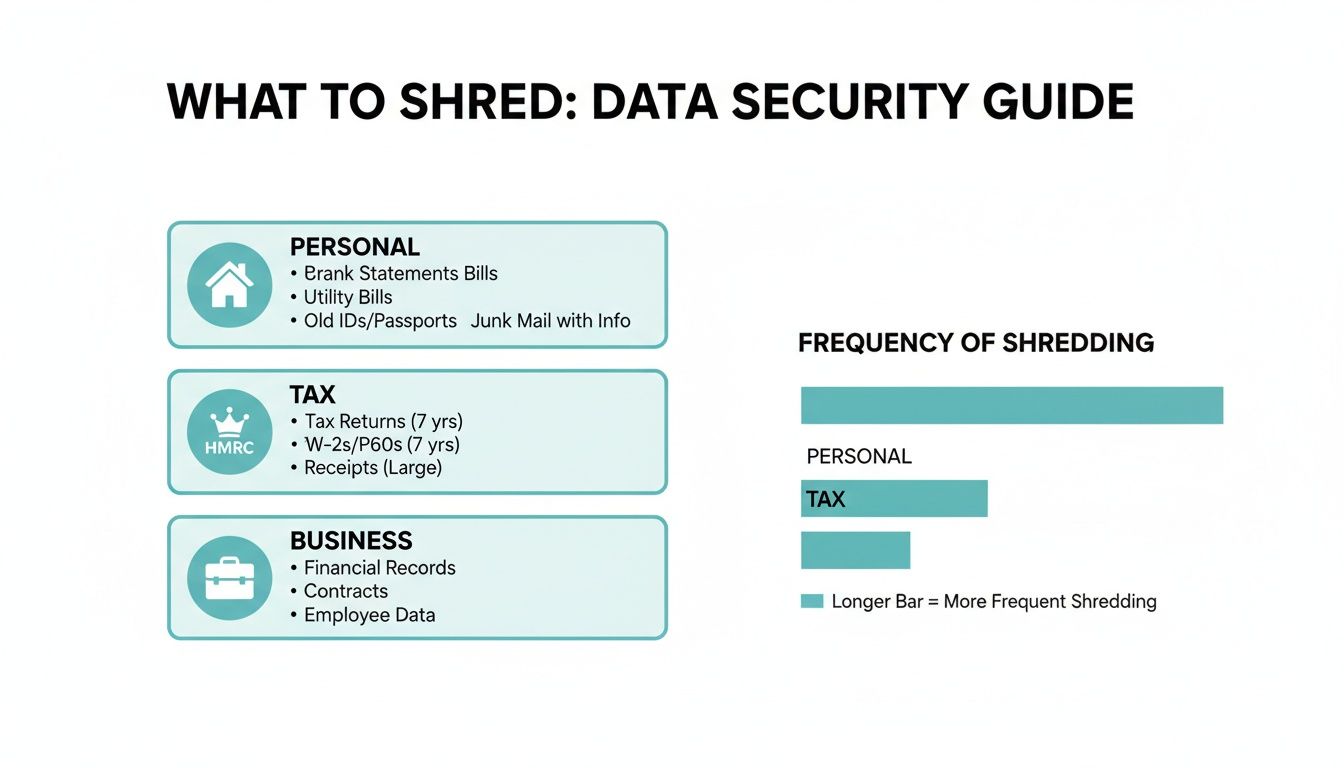
It’s a great reminder that whether it’s personal, tax, or business paperwork, having a consistent and secure disposal plan is non-negotiable for everyone.
Using Professional Shredding Services
When you’re looking at more than a couple of boxes, professional services start to look like a much more practical and secure solution. There are generally two ways to go about it:
-
Drop-Off Points: Many local copy shops, postal services, and even some storage facilities offer a drop-off shredding service. You just bring in your bags or boxes of paper, they weigh it, and then pop it into a secure, locked container to be destroyed later. It's a handy middle-ground, but it's vital to check that the provider is reputable and can tell you exactly when and how your documents will be shredded.
-
Collection Services: This is the gold standard, especially for businesses or anyone with a serious archive to clear out. A specialist company will either collect your documents for off-site shredding at their secure facility or, even better, bring a mobile shredding lorry right to your doorstep. This method is incredibly efficient—their industrial machines can tear through in minutes what would take a home shredder hours to get through.
The biggest advantage of using an authorised professional service is the Certificate of Destruction. This official document is your legal proof that the documents were destroyed securely and in line with data protection laws. For any business facing an audit, this piece of paper is absolutely essential.
For businesses juggling ongoing shredding needs and large document archives, managing the whole process is crucial. Many companies find that using smart storage units for business offers a secure, organised space to hold records during their retention period before they’re sent for certified destruction.
And while we're focused on paper here, it's just as important for businesses to think about shredding digital assets professionally. For example, looking into secure computer shredding services for B2B data and compliance ensures all your data, both physical and digital, is handled correctly.
Managing the Document Lifecycle Before You Shred
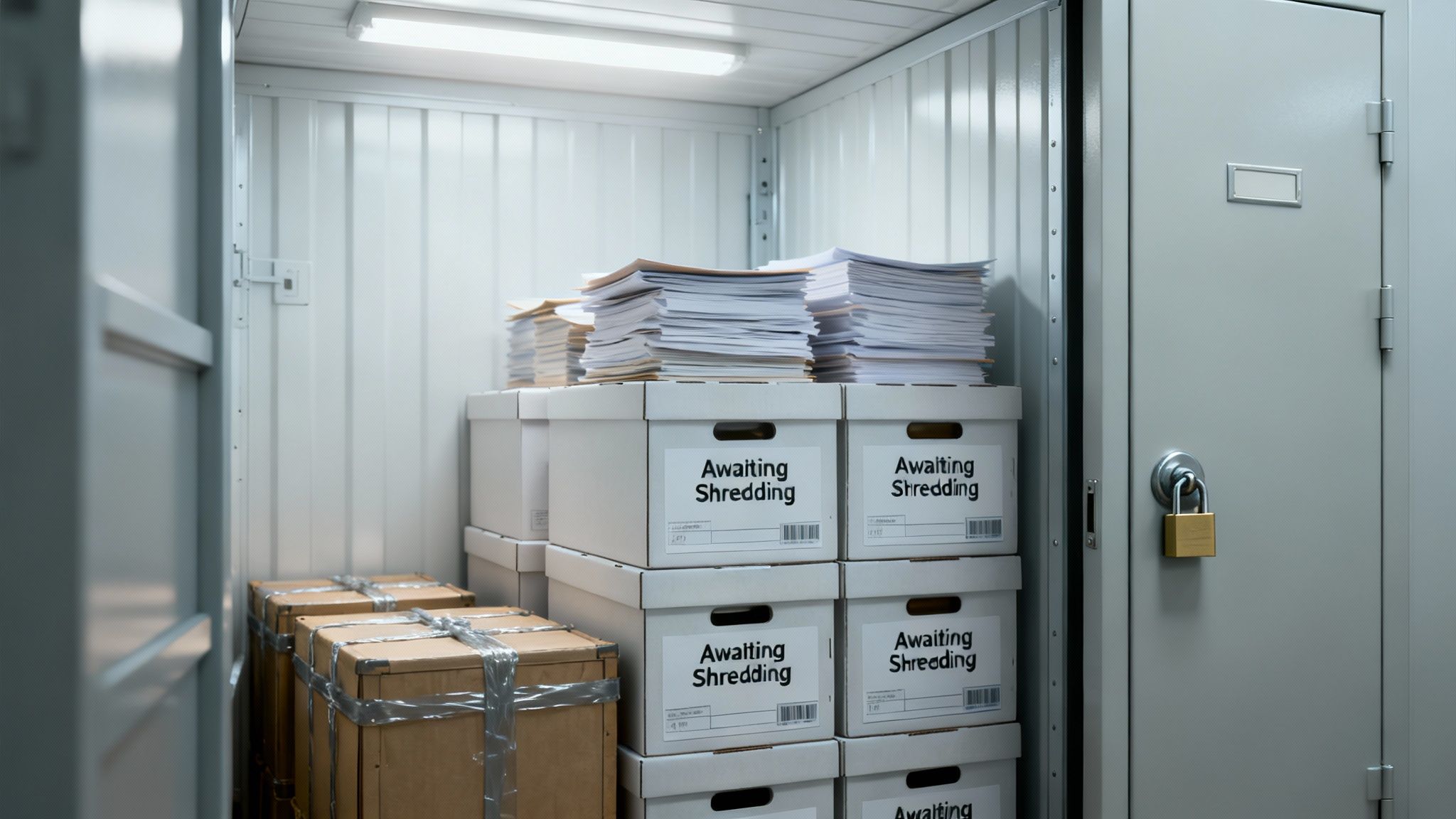
Secure disposal isn’t just about the final act of shredding. It’s a process that starts the very moment you decide a document is no longer needed day-to-day. How you handle sensitive files while they’re waiting for destruction is every bit as critical as the shredding itself.
Leaving boxes of old client records or financial statements in an unlocked stockroom or a damp garage is just asking for trouble. It creates a serious, and completely unnecessary, security risk.
This interim period is often the weakest link in the data security chain. A simple oversight can lead to a data breach, turning a routine clear-out into a compliance nightmare. The goal is to create a secure, controlled environment for these documents, closing any window of opportunity for prying eyes.
Creating a Secure Holding Area
The first step is to set up a dedicated, secure holding area for all documents marked for shredding. This doesn't need to be complicated, but it absolutely must be consistent.
A few effective options include:
- Locked Filing Cabinets: A simple but brilliant solution for smaller volumes. Dedicate a drawer or two specifically for papers awaiting disposal and make sure only authorised staff have the key.
- Secure Shredding Consoles: For businesses, these are the gold standard. They are locked bins, often provided by professional shredding companies, where staff can post documents through a narrow slot. Only the shredding service can get to the contents.
- A Designated Secure Room: If you've got the space, a locked storeroom or even a large cupboard can work perfectly as a central collection point before a bulk shredding collection is arranged.
It's crucial to think of this holding stage with the same security mindset you apply to your active files. If the information was sensitive enough to protect during its useful life, it remains just as sensitive while it awaits destruction.
The Role of Secure Self Storage
For larger clear-outs, like an end-of-year archive purge or a house move, trying to store everything on-site can quickly become a logistical headache. This is where professional self-storage becomes an invaluable part of your secure disposal plan.
A secure, climate-controlled storage unit offers the perfect interim solution. It gives you a safe, off-site location to consolidate, sort, and stage documents before calling in a bulk shredding service. For businesses and individuals across the Wirral, it guarantees end-to-end security and peace of mind, preventing sensitive files from cluttering up your active workspace or home. Keeping things organised is key; find out more about the best practices for inventory management to keep track of every box.
This approach fits perfectly with how modern confidential document disposal has evolved in the UK. Outsourced shredding is now a highly structured process, often involving locked consoles, collection by vetted staff, and destruction compliant with BS EN 15713 standards. Many organisations use secure self-storage to hold archives for their required retention period before transferring them for certified shredding. It's a methodical process that guarantees compliance from a document’s creation right through to its final, secure destruction.
Finalising Your Disposal and Creating a Routine
The physical act of shredding feels like the final hurdle, but the process isn't quite finished. A couple of crucial follow-up actions will lock down your compliance, handle your environmental duties, and most importantly, stop that paper mountain from growing right back.
For anyone using a professional service, the single most important document you’ll receive is the Certificate of Destruction. This isn't just a simple receipt; it’s a formal, legal document. It’s your proof that you’ve disposed of confidential waste responsibly and in line with UK data protection laws.
Should the Information Commissioner's Office (ICO) ever come knocking for an audit, this certificate is your definitive evidence of compliance. It details exactly what was destroyed, when, and how, giving you a complete and auditable trail that protects you and your business. Don’t just toss it in a drawer—file it securely.
Establishing a Sustainable Shredding Schedule
To prevent a future build-up, you need a simple, repeatable routine. Last-minute, ad-hoc clear-outs are always stressful and time-consuming, which is exactly when mistakes happen. A proactive schedule turns a major headache into a manageable habit.
Think about what works for you:
- For Households: An annual or bi-annual "shred day" usually does the trick. Try tying it to another yearly task, like preparing your self-assessment tax return or doing a spring clean, to make it a memorable part of your calendar.
- For Businesses: A quarterly or even monthly schedule is far more realistic. Regular, smaller shredding runs prevent documents from piling up in unsecured corners and ensure you stick to data minimisation principles.
The goal is to make shredding a predictable part of your operations, not an emergency reaction. A consistent routine minimises risk and makes sure sensitive information doesn't hang around for longer than necessary.
The Eco-Friendly Aspect of Shredding
Beyond just being compliant, responsible disposal has a massive environmental upside. One of the best things about using a reputable shredding service is their commitment to recycling. All that shredded paper is baled and sent off to mills to be pulped and repurposed into new paper products.
This closed-loop process means your commitment to data security doesn't have to come at an environmental cost. It transforms waste into a valuable resource, which helps support a more circular economy. For many businesses and individuals, this is a vital part of their corporate or personal responsibility.
Getting into a routine also helps you anticipate your needs. Over time, you'll get a much better sense of how much paper you're accumulating, which is really useful for planning. Understanding your volume helps when deciding if you have enough space for temporary storage or if you need to look at options like a small self-storage unit. If you're not sure, you can find helpful guidance on how much storage you might need to make an informed decision.
Got Questions About Document Shredding?
Even with the best plan in place, a few practical questions always pop up when it’s time to shred. Let’s tackle some of the most common queries to make sure you can get rid of your sensitive paperwork with total confidence.
Do I Need to Bother Removing Staples and Paper Clips?
If you're using a standard home or small office shredder, then yes, absolutely. Taking out staples, paper clips, and especially those chunky bulldog clips is a must. It’ll save the shredder's blades from damage and stop those infuriating paper jams that always seem to happen at the worst times.
But if you’re using a professional shredding service, you can forget all that fiddly prep work. Their industrial-grade machines are absolute beasts, built to chew through staples, clips, and even entire ring binders without breaking a sweat. It’s a huge time-saver and one of the best perks of going pro.
How Much Does Professional Document Shredding Cost in the UK?
The cost really depends on the service you go for and just how much paper you’ve got piled up.
For a one-off clear-out, most companies will charge by the sack or box. You can expect to pay somewhere in the region of £5 to £15 per container. If you’re a business needing regular collections, you’ll likely pay a monthly fee for a secure, lockable shredding console on your premises, which includes scheduled pick-ups and destruction.
A quick heads-up: on-site shredding, where the shredding lorry comes directly to you, is usually a bit pricier than off-site services where they take your documents to a secure facility. Always ask for a clear, itemised quote upfront so there are no nasty surprises like extra charges for collection or for that all-important Certificate of Destruction.
What Is a Certificate of Destruction and Do I Really Need One?
A Certificate of Destruction is a formal document you get from the shredding company. It’s your official proof that your documents have been securely and permanently destroyed, detailing exactly when, where, and how it happened.
For any business, this certificate isn’t just a nice-to-have; it’s absolutely essential. It serves as your legal audit trail, giving you concrete evidence that you’re complying with GDPR and the UK Data Protection Act 2018. If the Information Commissioner's Office (ICO) ever comes knocking, that certificate is your proof that you’ve handled your data disposal duties correctly and responsibly.
Is Burning My Old Documents a Safe Alternative to Shredding?
While chucking old papers on a bonfire might feel like a final and secure way to destroy them, it's definitely not a good idea here in the UK. For starters, it’s a serious fire hazard, and you could easily fall foul of local council rules on air pollution and bonfires.
More importantly, it’s not even a foolproof method. Tightly packed paper often doesn't burn through completely, meaning sensitive information can be left surprisingly intact and readable. And from a legal standpoint, you have zero proof of compliant disposal, leaving your business exposed. Professional shredding is safer, more reliable, and much better for the environment, as 100% of the shredded paper is recycled.
Managing your documents from creation to destruction is an ongoing job. If you find yourself needing a secure, flexible space to store archives before their shredding date or just want to clear some clutter from your home or office, Shield Self Storage has you covered. Our secure units in The Wirral provide the perfect environment to keep your documents safe. Get a fast quote and book online today.