
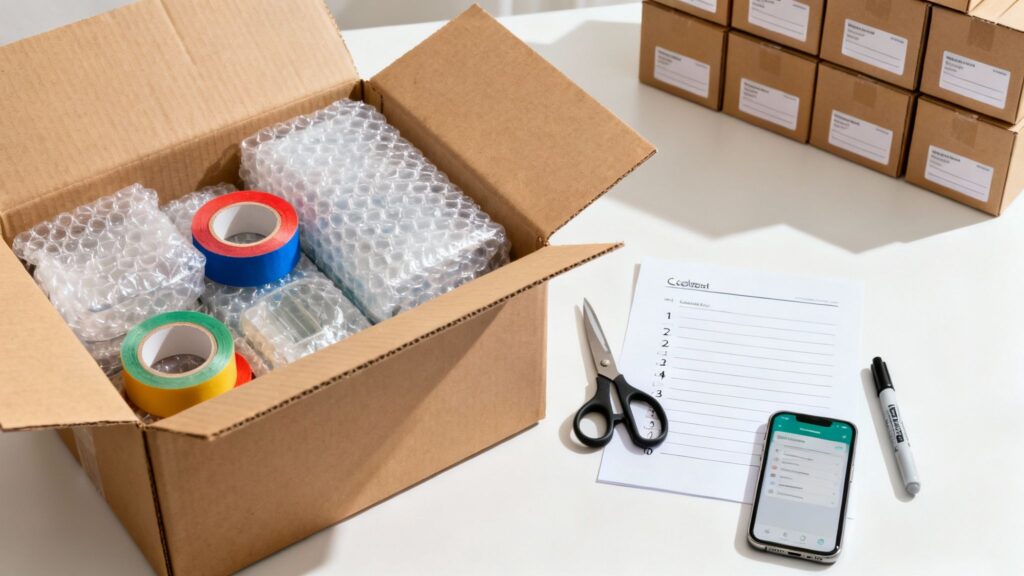
Moving house consistently ranks as one of life’s most stressful events, but with smart organisation and the right strategies, it doesn’t have to be. The key to a seamless transition lies entirely in the preparation, and that preparation begins with efficient packing. A well-executed packing plan not only safeguards your cherished belongings but also saves you significant time, money, and effort when you finally arrive at your new home. This guide provides a comprehensive roundup of essential moving house tips packing experts swear by, specifically designed to transform your move from chaotic to controlled.
We’ll cover everything from the crucial first step of decluttering your life before you even pick up a roll of tape, to the practical logistics of organising a self storage unit for maximum efficiency. These actionable insights will ensure you arrive at your new front door feeling prepared and in control, ready to unpack and settle in with ease. You'll learn how to categorise, label, and protect your possessions like a professional, turning what is often an overwhelming task into a manageable project. For a more in-depth understanding of efficient packing strategies, consider this proven guide for packing to supplement these tips. Whether you're moving across town or simply need to store items during a renovation, these techniques will streamline the entire process.
1. Declutter Before You Pack
The most effective packing tip has nothing to do with boxes or tape; it’s about reducing the volume of what you need to move in the first place. Decluttering before you pack is a non-negotiable first step that saves you time, money, and energy. Why pay to move, store, and unpack items you no longer need, use, or want? By systematically sorting through your belongings, you streamline the entire moving process and ensure you start life in your new home with a clean, organised slate.

How to Implement a Pre-Move Declutter
Start this process at least 4-6 weeks before your moving day to avoid feeling rushed. The goal is to make clear-headed decisions, not panicked ones. A popular and highly effective technique is the four-box method. As you go through each room, sort every item into one of four designated containers:
- Keep: These are the items you will be packing and taking to your new home.
- Donate: Items in good, usable condition that can benefit a local charity. Remember to schedule a collection service in advance if you have large furniture pieces.
- Sell: Belongings with resale value. Take clear photos and list them on online marketplaces promptly to give them time to sell.
- Discard: Anything that is broken, expired, or no longer usable.
Key Insight: Be ruthless and realistic. If you haven't used an item in the last 12 months, ask yourself honestly if you truly need it. Understanding the average house contents value can also help you prioritise what's worth the cost and effort of moving.
For items you're struggling to part with, such as seasonal decorations or sentimental belongings, consider a temporary solution. Placing them in a flexible self storage unit at Shield Self Storage allows you to make a decision later without cluttering your new space. This strategy is an essential part of any comprehensive moving house tips packing checklist. If you need inspiration on where to start, our guide on how to declutter your bedroom provides a great room-by-room blueprint.
2. Use the Right Packing Materials and Boxes
The quality of your packing materials directly impacts the safety of your belongings. While it might seem tempting to save money by using any old boxes, investing in sturdy, appropriate supplies is crucial for a successful move. High-quality materials not only protect your items during transit and storage but also make the packing process more efficient and organised, preventing damage, breakages, and stress on moving day.
How to Select the Right Supplies
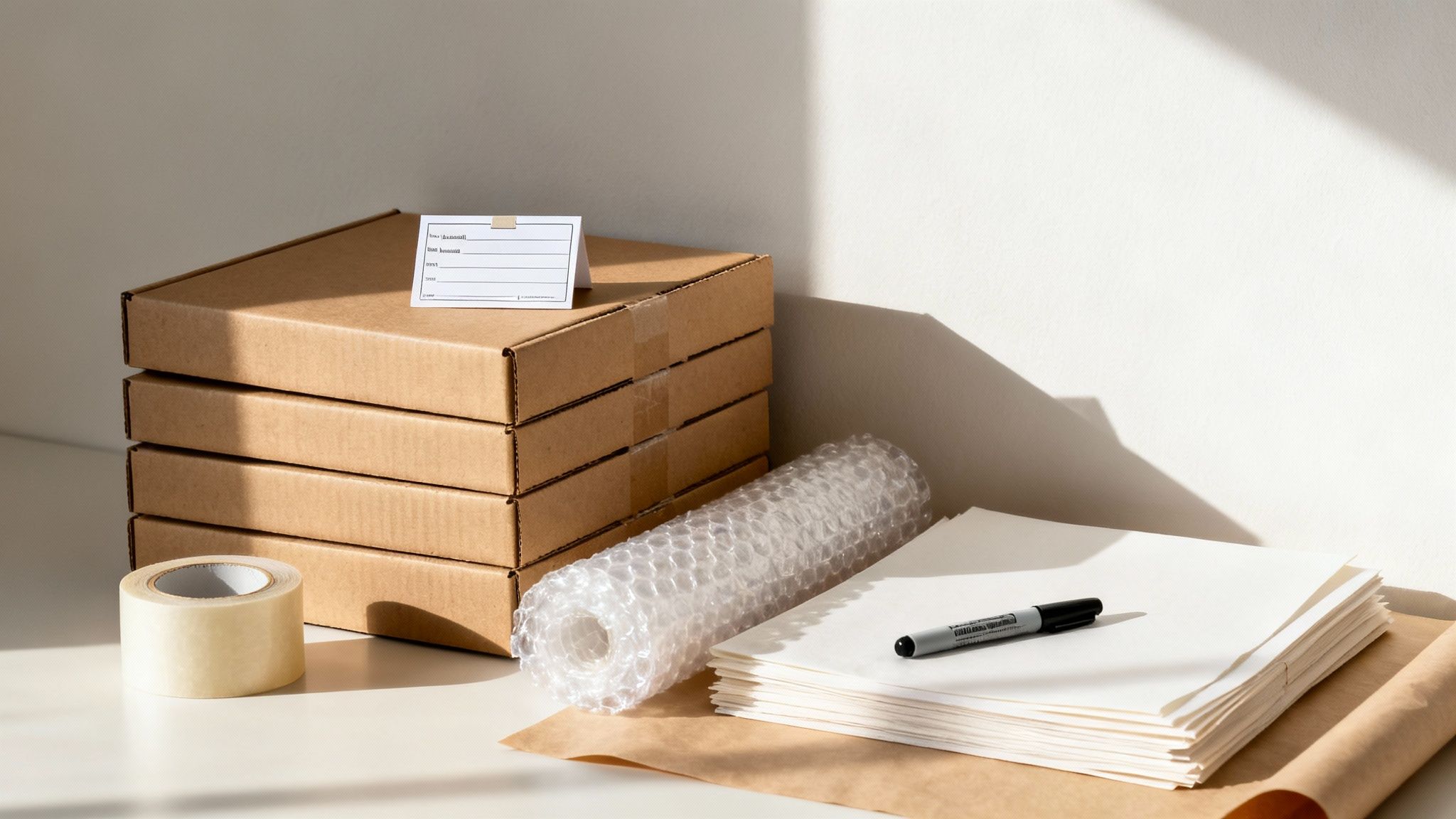
Start gathering your materials well in advance. Having everything on hand allows you to pack methodically without last-minute scrambles for tape or bubble wrap. Your essential toolkit should include a variety of box sizes, strong packing tape, wrapping paper, bubble wrap, and permanent markers for labelling.
- Vary Your Box Sizes: Use small boxes for heavy items like books and larger boxes for lighter, bulkier items such as linens and pillows. This keeps the weight of each box manageable.
- Invest in Quality Tape: Cheap tape often peels away, especially in changing temperatures, leading to boxes falling apart. A good quality packing tape ensures your boxes stay securely sealed.
- Use Proper Padding: Use packing paper or bubble wrap to cushion fragile items. Crumpled paper can also be used to fill empty spaces in boxes to stop contents from shifting.
- Label Everything Clearly: Label each box on multiple sides with its contents and the room it belongs in. This is one of the most vital moving house tips packing for an organised unpacking process.
Key Insight: Keep the weight of each packed box under 20kg (around 45-50 lbs). This not only makes them safer for you to lift but also ensures they can be stacked securely in a moving van or a self storage unit without the risk of crushing the boxes below.
For items requiring long-term protection, such as important documents or business inventory, consider specialised solutions. For example, using archival-quality boxes, which can be stored securely at a Shield Self Storage facility, protects sensitive paperwork from degradation. This strategic approach to materials ensures every item, from everyday crockery to valuable assets, is properly safeguarded.
3. Create an Inventory System and Label Everything Clearly
Once you’ve decluttered, the next crucial step is establishing a system to track what you're moving. A detailed inventory and clear labelling system might seem like extra work upfront, but it is one of the most effective moving house tips packing experts swear by. This methodical approach transforms a chaotic pile of boxes into a manageable, organised collection. It not only simplifies the unpacking process but also provides an essential record for insurance purposes and helps you locate specific items quickly, whether they are in your new home or a storage unit.
How to Implement Your Inventory and Labelling System
The key to success is consistency. Choose one method—a spreadsheet, a dedicated app, or a simple notebook—and stick with it for every single box. As you pack each box, assign it a unique number and log its contents before sealing it.
- Assign Unique Numbers: Number every box sequentially (e.g., 1, 2, 3…). Write this number prominently on at least two sides of the box.
- Create Your Inventory List: In your spreadsheet or notebook, create columns for: Box Number, Destination Room (e.g., Kitchen, Master Bedroom), and General Contents (e.g., "Kettle, toaster, mugs, coffee maker").
- Label with Detail: On each box, write the unique number, the destination room, and a brief summary of its contents. This saves you from having to open a dozen boxes just to find the kettle.
- Use Colour-Coding: For quick visual identification, assign a different coloured sticker or tape to each room. For instance, use blue for the kitchen, red for bedrooms, and green for the living room. This allows movers (and you) to place boxes in the correct rooms instantly.
Key Insight: Your inventory is not just for unpacking; it's a vital tool for peace of mind. For high-value items like electronics or jewellery, take photos and add a 'Condition' or 'Value' column to your spreadsheet. This documentation is invaluable if you need to make an insurance claim.
This system is especially beneficial when using self storage. Knowing that box #42 contains winter coats and boots means you can retrieve it from your Shield Self Storage unit without rummaging through everything. A well-organised inventory is the foundation of efficient storage use, a topic we explore further in our guide to the best practices for inventory management.
4. Pack Room by Room
Tackling your entire home at once is a recipe for chaos and burnout. A systematic, room-by-room approach is one of the most effective moving house tips packing experts recommend. By concentrating your efforts on one space at a time, you maintain order, prevent items from getting mixed up, and make the unpacking process significantly more manageable. This methodical strategy transforms an overwhelming task into a series of achievable, self-contained projects, ensuring a smoother transition from start to finish.
How to Implement Room-by-Room Packing
Begin this process by prioritising rooms based on how frequently you use them. This ensures your daily life is disrupted as little as possible in the final weeks before your move. As you complete each room, seal the boxes and stack them neatly against a wall, creating clear pathways and a sense of accomplishment.
- Start with the least-used rooms: Begin with spaces like guest bedrooms, the loft, or studies. Packing these areas first gets them out of the way without impacting your day-to-day routines.
- Save essential rooms for last: The kitchen, master bedroom, and main bathroom should be the final rooms you pack. You will need access to these items right up until moving day.
- Label everything clearly: On each box, write the destination room (e.g., "Kitchen," "Master Bedroom"), a brief summary of its contents ("Pots and Pans," "Bedside Lamps"), and a "FRAGILE" warning if needed.
- Create distinct piles: As you pack a room, physically separate boxes destined for your new home from those going into self storage. This avoids confusion on moving day. For example, seasonal decorations from the loft can go directly into a "STORAGE" pile.
Key Insight: A colour-coding system is a simple yet powerful enhancement to this method. Assign a different coloured sticker or marker to each room and apply it to every corresponding box. This allows movers to identify a box's destination at a glance, speeding up the unloading process immensely.
This strategy is particularly useful when you have items that won't be needed immediately in your new home. For instance, if you are downsizing or planning renovations, packing non-essential furniture or seasonal equipment from a specific room directly into boxes for a Shield Self Storage unit keeps them safe and out of your way. This focused approach ensures nothing is misplaced and every box has a clear purpose.
5. Pack Heavy Items in Small Boxes, Light Items in Large Boxes
One of the most common moving mistakes is improper weight distribution in boxes. It’s a simple law of physics: putting heavy items like books or tinned goods into a large box makes it dangerously heavy and prone to breaking. Conversely, filling a small box with a light, bulky duvet is an inefficient use of space. The golden rule of packing is to match the box size to the item's weight, not its volume, to ensure a safe and efficient move.
This fundamental packing strategy prevents personal injury from lifting, stops boxes from collapsing, and makes stacking inside a moving van or storage unit much safer. By packing heavy belongings in small, manageable boxes and light, bulky items in larger ones, you create a collection of uniformly liftable containers. This is a core principle in any professional list of moving house tips packing for a reason: it protects both your back and your belongings.
How to Distribute Weight Correctly
Applying this tip is straightforward. Before you start packing a room, lay out your different-sized boxes and assess the items you need to pack. Your goal is to keep any single box from becoming a two-person job.
- Heavy Items: Think books, kitchen crockery, tinned foods, tools, and small appliances. These should always go into small boxes. While it may seem like you're using more boxes, each one will be easy and safe to lift.
- Light Items: Items like linens, towels, cushions, clothing, and children's toys are perfect for your largest boxes. They fill the space without adding significant weight, preventing the box from being crushed when stacked.
- The Weight Test: A great rule of thumb is to aim for a maximum weight of around 20 kg (or 40-50 lbs) per box. If you can't comfortably lift a packed box with one hand, it's too heavy and the contents should be redistributed.
- Stacking Strategy: When loading the moving van or your Shield Self Storage unit, always place the small, heavy boxes on the bottom and the larger, lighter boxes on top. This creates a stable base and prevents lighter items from being crushed.
Key Insight: Don't leave empty space in your boxes. Fill any gaps in large boxes containing light items with crumpled packing paper or towels. This adds structural integrity and prevents the box from caving in when other items are stacked on top of it.
This technique is crucial for an organised and damage-free move. By keeping box weights manageable, you not only make the physical labour easier but also simplify the process of unpacking at your new home, ensuring your possessions arrive in the same condition they left in.
6. Use Vacuum Seal Bags for Soft Items
One of the most transformative moving house tips packing experts swear by involves shrinking your belongings. Vacuum seal bags are a game-changer for soft, bulky items like clothing, duvets, pillows, linens, and curtains. By removing all the air from the bag, you can compress these items to a fraction of their original size, often saving up to 75% of the volume. This not only creates a significant amount of extra space in your moving van or storage unit but also protects your textiles from dust, moisture, and pests during transit and storage.
How to Make the Most of Vacuum Sealing
To maximise efficiency and protect your belongings, it’s important to use vacuum seal bags correctly. Start by ensuring every item is completely clean and dry before sealing, as any trapped moisture can lead to mildew. For best results, fold items neatly before placing them inside, and avoid over-filling the bags, which can cause the seal to fail under pressure. This method is particularly effective for:
- Seasonal Wardrobes: Compress bulky winter coats, jumpers, and ski gear for the move.
- Bedding: Easily pack multiple duvets, pillows, and mattress protectors.
- Linens: Keep towels, curtains, and spare bed sheets compact and clean.
- Children’s Soft Toys: Protect and shrink that mountain of teddy bears and stuffed animals.
Key Insight: While fantastic for most textiles, avoid vacuum sealing delicate natural fibres like wool or silk, as the intense compression can damage their structure and cause permanent wrinkling. Always label each bag with its contents and the date it was sealed.
This space-saving technique is invaluable when you need to make every square foot count. For families placing seasonal items into a Shield Self Storage unit, using vacuum bags allows you to rent a smaller, more cost-effective space. It’s a simple, low-cost strategy that dramatically improves the organisation and efficiency of your entire move.
7. Wrap Furniture and Protect Delicate Items
Properly protecting your furniture and delicate belongings is a crucial step that prevents costly damage during transit. Scratches, dents, moisture, and breakages are common moving-day mishaps, but they are almost entirely preventable with the right materials and techniques. Taking the time to wrap each large item and secure fragile pieces ensures they arrive at your new home, or at a storage unit, in the same condition they left. This is one of the most important moving house tips packing experts swear by.
How to Protect Your Belongings Effectively
Start by gathering professional-grade materials such as furniture blankets, mattress bags, bubble wrap, and corner protectors. Avoid using old bedsheets, as they offer minimal protection against impact. As you prepare, photograph valuable or antique items for insurance records before you begin wrapping them.
- Wrap Furniture Individually: Use heavy-duty moving blankets or pads for large items like sofas, tables, and cabinets. Secure the blankets firmly with packing tape or shrink wrap, ensuring no part of the surface is exposed.
- Use Mattress Bags: Protect your mattresses from dirt, moisture, and pests by sealing them inside dedicated plastic mattress bags. This is especially vital if the mattress will be placed in storage.
- Protect Corners and Edges: Attach cardboard or plastic corner protectors to the edges of tables, dressers, and picture frames. These areas are the most vulnerable to chips and dents.
- Handle Delicate Items with Care: For mirrors, artwork, and glass tabletops, use specialised cardboard mirror boxes. Wrap ceramics and collectibles in acid-free tissue paper before placing them in cushioned boxes.
Key Insight: When placing wrapped items into a vehicle or storage unit, ensure they do not rest directly against walls, which can attract moisture. Always leave a small air gap for circulation. The goal is to create a protective cocoon for each item.
For those needing a secure space during a move, understanding how to prepare your items is critical. A Shield Self Storage unit is an ideal solution for keeping furniture safe, whether for a few weeks or long-term. Following these steps will ensure your belongings remain pristine. Our comprehensive guide provides more expert advice on how to store furniture in storage to maintain its condition.
8. Pack an Essentials/First Night Box
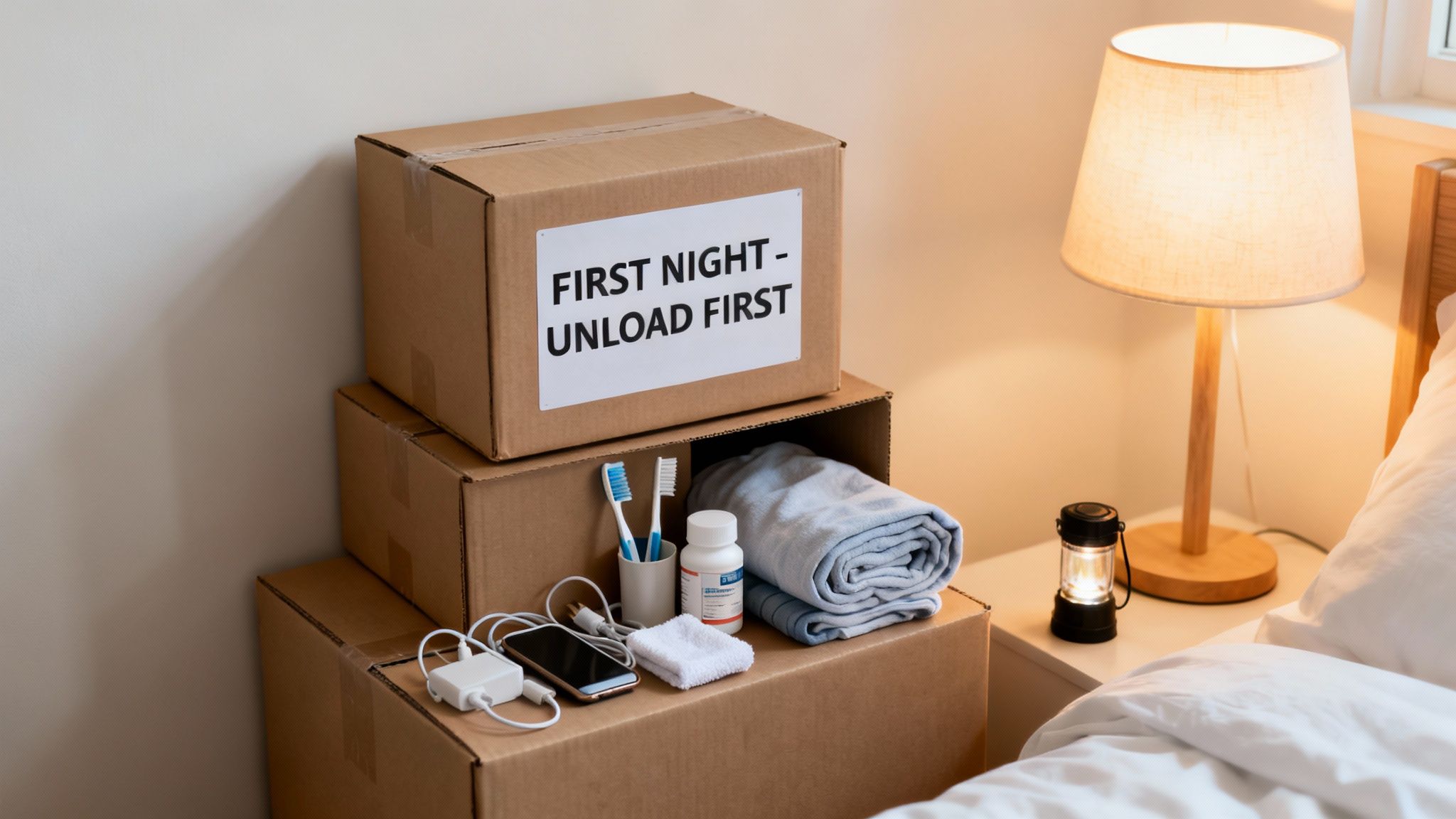
After a long and exhausting moving day, the last thing you want is to frantically search through dozens of identical boxes for your toothbrush, phone charger, or a clean set of clothes. An essentials box, often called a "first night box," is your personal survival kit for the first 24-48 hours in your new home. This single, clearly labelled container holds everything you’ll need immediately upon arrival, preventing chaos and allowing you to rest and recuperate before the real unpacking begins.
How to Assemble the Perfect First Night Box
Prepare this box in the final day or two before your move, ensuring you only pack items you won't need until you arrive at the new property. The goal is to keep it accessible at all times, so it should be the very last thing loaded onto the moving van and the first thing unloaded. Better yet, transport it in your own car to guarantee it doesn’t get lost among the other boxes. A well-prepared essentials box is a cornerstone of effective moving house tips packing.
- Personal Items: Include a change of comfortable clothes and pyjamas for each family member, essential toiletries (toothbrush, toothpaste, soap, deodorant), and any prescription medications.
- Electronics & Comfort: Pack phone and laptop chargers, a portable speaker, and perhaps a book or tablet. For families, include children's favourite toys or comfort items.
- Kitchen Basics: A kettle, tea bags or instant coffee, mugs, a few snacks, and some basic cutlery will be invaluable for a much-needed break.
- Practical Tools: A small tool kit (screwdriver, Allen keys), a torch, scissors or a box cutter, and bin bags will prove incredibly useful.
- Important Documents: Keep passports, new house documents, and moving company contracts in this box for easy access.
Key Insight: Label this box on all sides with a bold, unmissable marker: "OPEN FIRST – ESSENTIALS". This ensures that no matter how it's stacked, you or your movers can identify it instantly. Never, under any circumstances, should this box be placed into a self storage unit; its purpose is immediate accessibility.
9. Distribute Weight Evenly and Stack Smartly in Storage Units
How you load your self storage unit is just as crucial as how you pack your boxes. A strategic approach to stacking and weight distribution not only maximises the available space but also protects your belongings from damage and ensures you can access them easily. Simply piling boxes randomly creates instability, risks crushing lighter items, and turns finding a specific item into a frustrating, time-consuming task. Organising your unit methodically from the start is a key part of any successful moving house tips packing strategy.
How to Implement Smart Storage Stacking
Before you move a single box into the unit, take a moment to sketch a rough floor plan. This helps you visualise where everything will go, ensuring you create a logical and accessible layout. The goal is to build stable, well-organised stacks that make the most of the vertical height while keeping items safe.
- Foundation First: Always place the heaviest, sturdiest boxes on the bottom. This creates a solid base and prevents lighter, more delicate items from being crushed.
- Aisles are Essential: Leave a clear walkway, at least 2-3 feet wide, from the door to the back of the unit. This central aisle allows you to access items without having to unpack everything.
- Group and Zone: Organise the unit into zones based on room or category, such as "Kitchen," "Bedding," or "Office Files." This makes locating specific boxes much simpler.
- Uniformity is Key: Use boxes of a similar size where possible to create stable, uniform columns that are less likely to topple. Avoid stacking boxes higher than shoulder height for safety and ease of access.
Key Insight: Treat your storage unit like a library, not a landfill. The ability to retrieve an item quickly and safely is paramount. Consider placing furniture against the walls to maximise floor space and putting frequently needed items near the entrance at chest height.
Properly utilising a storage unit can be a game-changer during a move, providing a secure space for items you aren't ready to place in your new home. Taking the time to understand the different options available ensures you choose a space that fits your needs perfectly. For a detailed overview, our guide explaining the various sizes of storage units offers valuable information to help you make the right choice.
10. Choose the Right Storage Solutions for Different Item Types
Not all of your belongings require the same level of care, and therefore, not all storage is created equal. A crucial element of any moving house tips packing strategy is matching your items to the correct type of storage unit. Choosing the right environment protects your possessions from damage caused by extreme temperatures, humidity, and other environmental factors, ensuring they remain in the same condition as when you packed them. This is especially vital for delicate, valuable, or sentimental items.
How to Select the Right Storage Unit
The first step is to take inventory of what you plan to store and categorise items based on their material and sensitivity. This will determine whether a standard unit is sufficient or if a climate-controlled unit is necessary. A climate-controlled unit maintains a stable temperature and humidity level, protecting against mould, mildew, rust, and warping.
- Climate-Controlled Storage: Essential for sensitive items. This includes wooden furniture, musical instruments (like pianos and guitars), artwork, electronics, antiques, vinyl records, photographs, and important documents that could be damaged by moisture.
- Standard Storage: Perfectly suitable for more robust, general household goods. Items like garden tools, sturdy furniture, books, seasonal clothing (if packed correctly in vacuum-sealed bags), and kitchenware are typically safe in a standard unit.
Key Insight: The extra cost for climate control is an investment in protecting your most valuable possessions. Documenting these high-value items before storage is also a wise step for insurance purposes, providing a clear record of their condition.
When organising your move, think about the long-term safety of your belongings. If you are storing items for an extended period, particularly through seasonal changes, a climate-controlled environment provides peace of mind. Getting the size right is also key to avoiding wasted space and money; understanding how much storage you might need will help you make an informed decision and budget effectively for your moving and storage expenses.
Top 10 Moving & Packing Tips Comparison
| Item | Implementation Complexity | Resource Requirements | Expected Outcomes | Ideal Use Cases | Key Advantages |
|---|---|---|---|---|---|
| Declutter Before You Pack | Moderate — time-consuming decision process | Time, staging area, donation/sale channels | Reduced volume (≈20–40%), lower moving/storage costs | Downsizing, long-distance moves, renovations | Lower cost, cleaner start, possible resale/donation tax benefits |
| Use the Right Packing Materials and Boxes | Low–Moderate — source and use correct supplies | Quality boxes, tape, bubble wrap, packing paper | Better protection, stable stacking, efficient space use | Fragile items, long-term storage, professional moves | Damage prevention, reusable/recyclable options, neat stacking |
| Create an Inventory System and Label Everything Clearly | Moderate–High — detailed documentation and upkeep | Time, spreadsheet/app, labels, camera | Quick retrieval, insurance support, organised unpacking | Valuable items, business archives, long-term storage | Faster locating, evidence for claims, reduces search time |
| Pack Room by Room | Low–Moderate — requires discipline and order | Colour labels, boxes, staging space | Maintained organisation, faster unpacking, less mixing | Families, staged moves, multi-room homes | Logical unpacking flow, clear priorities, less confusion |
| Pack Heavy Items in Small Boxes, Light Items in Large Boxes | Low — simple sorting by weight | Assorted box sizes, weight checks or scales | Safer handling, stable stacks, reduced box failure | Books, archived files, solo movers | Prevents collapse, reduces injury risk, stack stability |
| Use Vacuum Seal Bags for Soft Items | Low — simple sealing but needs vacuum access | Vacuum-seal bags, vacuum cleaner, dry items | Up to ~75% volume reduction, dust/moisture protection | Seasonal clothing, students, long-term textile storage | Significant space savings, environmental protection of textiles |
| Wrap Furniture and Protect Delicate Items | Moderate — time- and labour-intensive | Furniture blankets, bubble wrap, corner protectors, tape | Reduced scratches/dents, moisture protection, preserved condition | Antiques, mattresses, mirrors, artwork | Protects high-value items, lowers insurance claims risk |
| Pack an Essentials/First Night Box | Low — basic planning and packing | One small box, checklist of essentials | Immediate access to necessities on arrival | Every mover, families, pet owners | Reduces moving-day stress, ensures critical items available |
| Distribute Weight Evenly and Stack Smartly in Storage Units | Moderate — requires planning and layout | Uniform boxes, dolly, floor plan, aisle space | Maximised space, safe retrieval, reduced damage | Long-term storage, mixed-size moves, businesses | Space optimisation, safe access, prevents crushing |
| Choose the Right Storage Solutions for Different Item Types | Moderate — assessment and selection required | Possible climate-controlled unit, security, budget planning | Appropriate environmental protection, reduced damage risk | Electronics, artwork, documents, vehicles | Preserves sensitive items, balances cost vs protection |
Packing Up: Your Next Steps to a Successful Move
Navigating a house move can often feel like an overwhelming puzzle, but with the right strategy, it transforms into a manageable and even rewarding project. By now, you’ve explored a comprehensive toolkit of moving house tips packing techniques, each designed to bring order, efficiency, and peace of mind to your relocation. The journey from a cluttered starting point to a perfectly organised new home is built upon these foundational principles.
The core message throughout this guide is that preparation is paramount. A successful move doesn’t begin when the first item is placed in a box; it starts with the crucial decision to declutter. Letting go of what you no longer need is the single most effective way to save time, money, and energy. This act of simplification creates a ripple effect, making every subsequent step, from sourcing materials to labelling boxes, significantly easier.
Key Takeaways for a Seamless Transition
Let’s distil the most critical insights from our packing masterclass. Mastering these concepts will be the difference between a stressful ordeal and a smooth, systematic move:
- Organisation is Your Strongest Ally: The power of a detailed inventory and a clear, consistent labelling system cannot be overstated. Knowing exactly what is in each box and where it belongs eliminates the frustrating guesswork upon arrival. This structured approach, combined with a room-by-room packing plan, prevents you from feeling overwhelmed.
- Technique Matters More Than Speed: Rushing the packing process is a false economy. Taking the time to use the right materials, wrap fragile items meticulously, and distribute weight correctly in boxes prevents costly breakages and potential injuries. Remember the golden rule: heavy items in small boxes, light items in large boxes.
- The "First Night Box" is Non-Negotiable: This small but mighty box is your lifeline during the initial 24-48 hours in your new home. Packing it with intention, including everything from toiletries and medications to phone chargers and a kettle, ensures your immediate needs are met without having to frantically search through dozens of other containers. It's a simple act of self-care that sets a positive tone for your new beginning.
Your Actionable Next Steps
Armed with this knowledge, your next step is to translate theory into action. Begin by creating your personalised moving timeline. Work backwards from your move-in date and schedule specific weekends or evenings dedicated to decluttering, sourcing supplies, and packing one room at a time. This methodical approach breaks the monumental task into a series of achievable milestones.
As you implement these moving house tips for packing, you will likely identify items that don't fit into your immediate plans. Perhaps you're downsizing, renovating, or simply need a temporary home for seasonal belongings or furniture. This is where strategic use of self storage becomes an invaluable part of your moving toolkit. It provides the breathing room necessary to unpack and organise at your own pace, without being crowded by non-essential items. A secure, flexible storage unit acts as a bridge between your old life and your new one, ensuring your possessions are safe until you are ready for them. Embracing this flexibility is key to a low-stress relocation.
Ready to secure that vital breathing room for your move? Shield Self Storage offers clean, secure, and accessible units perfect for bridging the gap between homes. Explore your options and get an instant quote to make your move smoother and more organised.