Deciding on the right secure documents storage is a big deal. Get it right, and you’ve got compliance, security, and peace of mind sorted. It really comes down to two paths: the old-school physical archive in a secure facility or modern digital storage in the cloud. The best route for you depends entirely on how you need to access, protect, and preserve your documents for the long haul.
Understanding Your Secure Document Storage Options
When you’re trying to get a handle on important paperwork, the first big decision is whether to go physical or digital. Each has its own clear advantages, and figuring them out is the first step to building a solid document management plan. Honestly, a lot of organisations I've worked with land on a hybrid approach, mixing the strengths of both to get the most complete protection.
This need for professional oversight has created a pretty significant industry. The UK's Document Management Services sector, which covers both physical and digital secure documents storage, recently hit a market size of £1.4 billion. That figure represents a steady growth of 3.3% over the last five years, which just goes to show how much businesses are relying on specialists to handle everything from company records to sensitive client files. You can dig into more industry growth insights on ibisworld.com.
Physical vs. Digital: Which Is Right for You?
Physical storage is the traditional, time-tested method. We’re talking about placing original paper documents—think contracts, deeds, or historical records—into a purpose-built, secure facility. This is the go-to option for anything that legally requires an original hard copy or for materials that aren't easy to digitise, like old blueprints or large-format plans. It gives you a tangible layer of security against digital threats like hacking or data breaches.
On the other side, you've got digital storage. This involves scanning your documents and saving them to secure servers, usually in the cloud. The massive benefits here are immediate accessibility from anywhere, powerful search functions, and dead-simple sharing. It’s perfect for the documents you need for daily operations, like invoices, employee records, or client files that your team needs to collaborate on.
This flowchart can help you figure out which path makes the most sense for your needs.
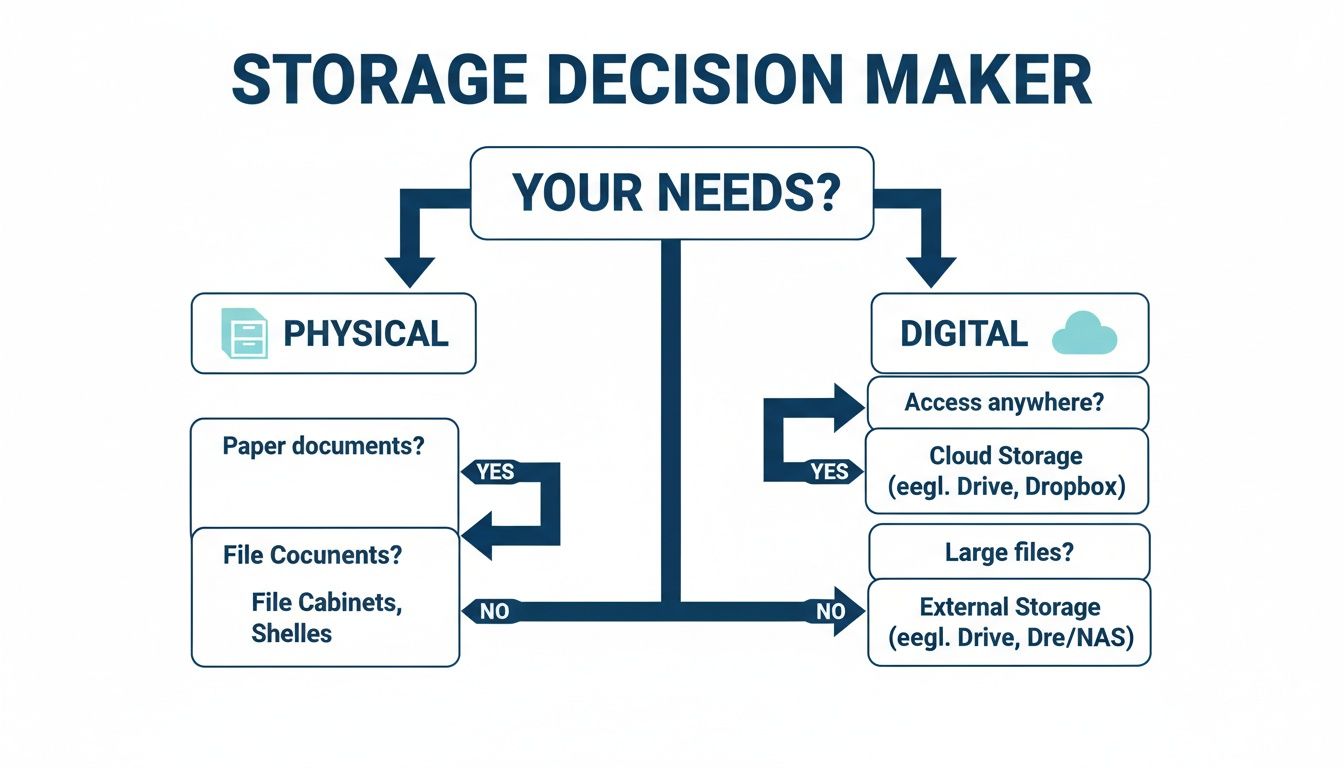
As you can see, the choice really hinges on whether your top priority is preserving original hard copies or enabling instant, remote access. A well-thought-out strategy often uses both, creating a system that’s both secure and efficient. For many companies, a professional off-site location is the cornerstone of their physical archiving plan; you can explore our guide on effective business storage solutions to learn more.
What to Demand from a Secure Physical Storage Facility
When you hand over your physical documents, you're placing an enormous amount of trust in a storage provider. Real secure documents storage goes way beyond a simple padlock on a unit door. It's about a multi-layered defence system designed to protect your sensitive information against every conceivable threat. Knowing what these non-negotiable features are is the only way to properly vet a facility and ensure your critical archives are genuinely safe.
The absolute foundation of any secure facility is constant, vigilant monitoring. A single camera pointed at the entrance just doesn't cut it.
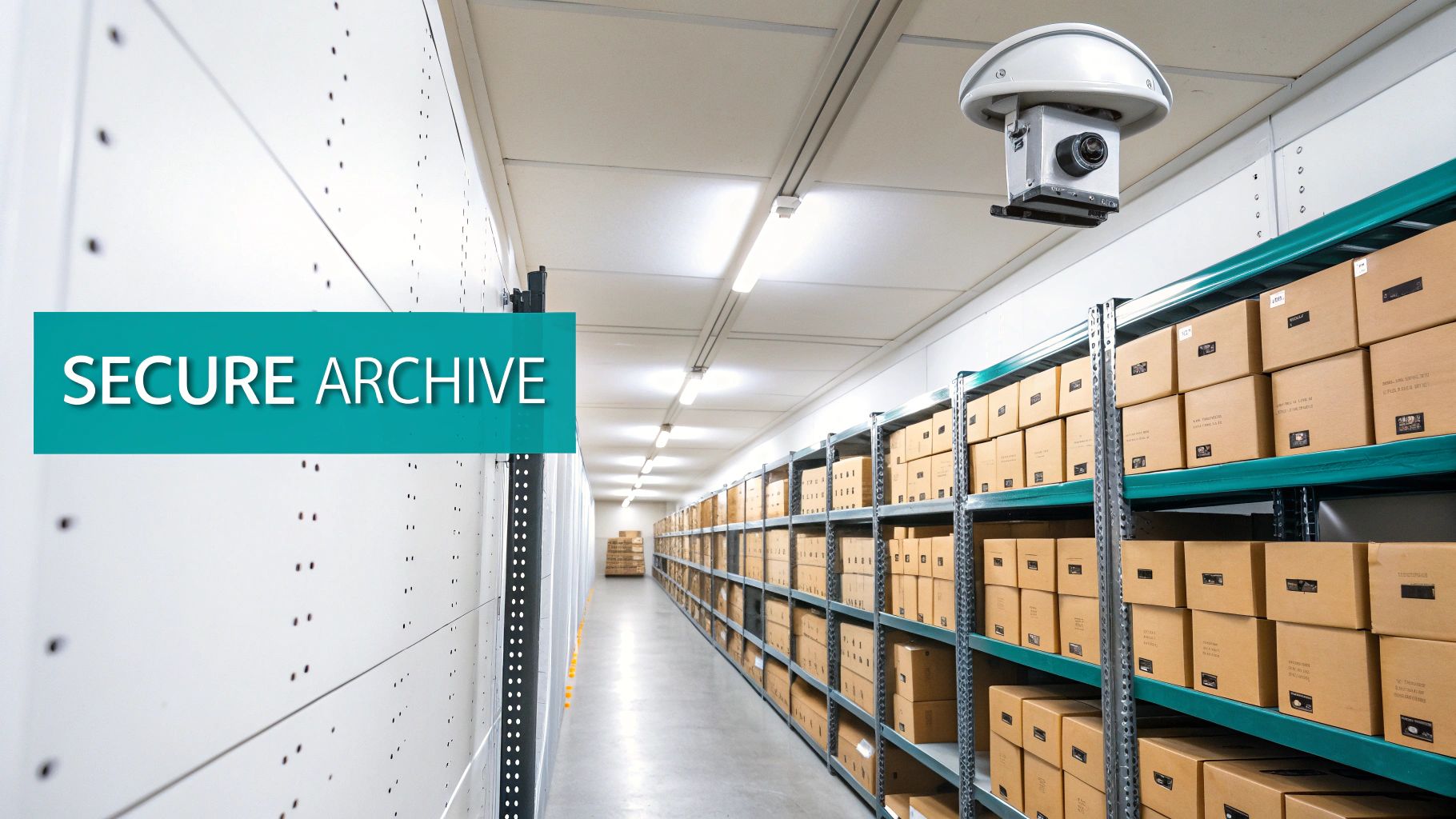
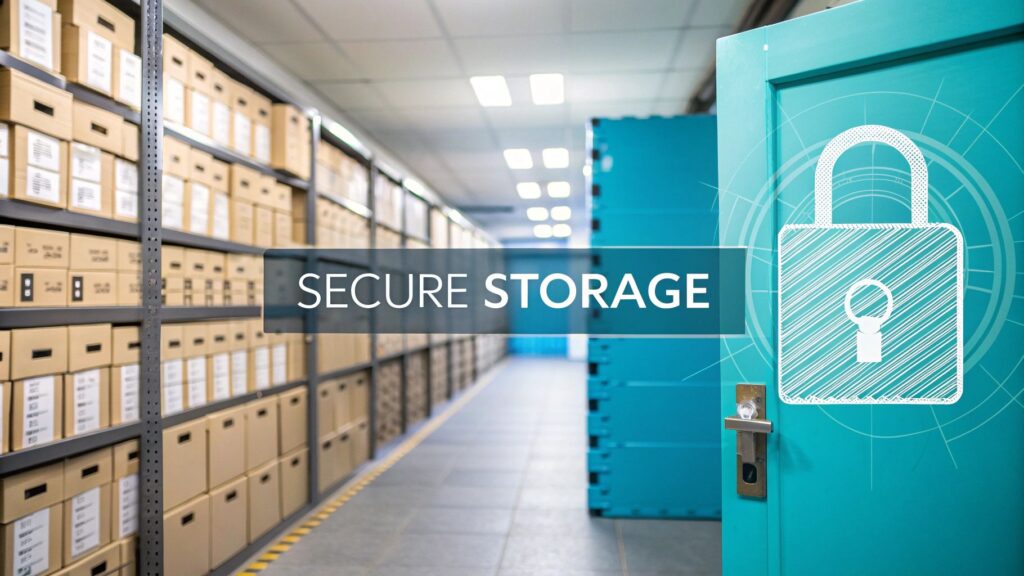
You need to demand 24/7 CCTV surveillance that covers all the critical areas—entrances, exits, corridors, and right down to the individual storage zones. This creates a complete visual record that not only deters potential intruders but also provides invaluable evidence if an incident ever occurs.
Advanced Access Control Systems
Beyond just watching, controlling who gets in—and where they can go inside—is paramount. Traditional keys are a liability; they can be lost, stolen, or copied, creating massive security holes. Modern facilities use far more robust methods.
These advanced systems should include:
- Keypad or Fob Entry: Requiring a unique code or an electronic fob ensures only authorised people can get into the main building and specific floors.
- Biometric Scanners: For the highest level of security, some top-tier facilities use fingerprint or retina scanners, which make unauthorised access virtually impossible.
- Individual Unit Alarms: Each storage space can be individually alarmed, triggering an immediate alert if anyone tampers with it.
This tiered approach means that even if one security layer is somehow bypassed, others are standing in the way. It’s also worth noting that for organisations needing serious protection on their own premises, solutions like advanced evidence lockers offer a similar level of ultimate security, which is crucial for safeguarding highly sensitive materials.
Environmental and Fire Protection
Human threats are only half the battle. The environment inside a storage unit can be just as destructive to paper, photos, and old magnetic tapes over time. Your standard office air conditioning isn't good enough for long-term preservation.
True archival-grade storage requires precise climate and humidity control. This is what stops the slow, creeping degradation caused by dampness, which leads to mould, and excessive dryness, which makes paper brittle and fragile.
A professional facility will maintain a stable environment all year round, protecting your documents from the kind of silent damage that can render them completely useless.
On top of that, a comprehensive fire suppression system is absolutely non-negotiable. Look for systems that go beyond basic smoke detectors, like heat sensors and specialised fire retardants designed to extinguish flames without causing catastrophic water damage to your paper documents. This ensures your archives are protected from both the fire and the method used to fight it.
Comprehensive Insurance and Support
Finally, even with the best systems in the world, things can still go wrong. That's why any reputable provider will have comprehensive insurance cover. Don't be shy—ask to see their policy and make sure you understand what it covers, including fire, theft, and water damage. This provides a final layer of financial protection and, just as importantly, shows the facility has confidence in its own security.
When you're choosing a partner for your archiving, asking direct questions about these features is vital. Many businesses find a balanced approach works best, combining secure off-site archiving with well-organised on-site files. To get your workspace in order, take a look at our solutions for office storage units that can help manage your day-to-day document needs. By insisting on these critical layers of security, you can have real confidence that your documents are protected from every angle.
Navigating the World of Digital Document Security
Taking your archives digital might feel like a huge leap, but the security payoff is massive when you get it right. Proper secure documents storage in the digital world is about more than just scanning papers. It’s about building a fortress around your most valuable information to defend against modern threats. That means understanding the key components that keep your data safe, locked down for authorised eyes only, and fully compliant with UK law.
This shift is happening all over the UK. The national data storage market recently hit an impressive £8.8 billion and is expected to rocket to £34.2 billion by 2035. This boom is driven by businesses hunting for secure, flexible solutions that tick all the boxes for GDPR and UK data protection, with a heavy focus on advanced encryption and keeping data on UK soil. You can find more details on the UK data storage market on futuremarketinsights.com.
Core Pillars of Digital Security
To create a genuinely secure digital archive, you need a few layers of protection working together. Think of it like securing your house: you need strong locks, a reliable alarm system, and a way to check who’s coming and going.
The first and most important layer is end-to-end encryption. Imagine sending a letter in a locked box that only the person you’re sending it to has the key for. That's pretty much what encryption does for your files. It scrambles them into a completely unreadable format while they're being stored and transferred, making them useless to anyone who might intercept them.
Next up is multi-factor authentication (MFA). This is like needing both a key and a secret PIN to get into your house. MFA makes users prove their identity in more than one way—usually with a password plus a one-time code sent to their phone. It dramatically cuts the risk of a break-in, even if a password gets stolen.
Choosing Your Cloud Environment
Not all digital storage is created equal. The type of cloud you choose has a huge impact on your security, costs, and how much control you have. Getting your head around the main models is vital for picking the right one for your business.
Here’s a simple breakdown of the three main cloud options:
- Public Cloud: Run by providers like Amazon Web Services or Google Cloud, this is a bit like renting a flat in a large apartment building. You share the server infrastructure with other businesses. It’s affordable and easy to scale up, but you have less direct control over security.
- Private Cloud: With this option, the entire cloud setup is dedicated solely to your organisation. This gives you the ultimate level of control and security, making it perfect for businesses with strict compliance rules, though it does come with a higher price tag.
- Hybrid Cloud: This approach is the best of both worlds. It lets you mix public and private clouds, so you can keep your most sensitive documents on a private server while using the more cost-effective public cloud for everyday files. It strikes a powerful balance between security, scale, and cost.
A smart hybrid setup lets a business enjoy the cost savings of the public cloud for day-to-day work while keeping its most critical data locked down in a private, highly controlled environment.
The Role of Audits and AI
Once you’re set up, you can’t just forget about it. Ongoing vigilance is what keeps your digital security strong. Regular third-party security audits are a must. These are independent checks that poke and prod your storage provider’s systems for any weak spots, giving you objective proof that their security is up to scratch.
Artificial Intelligence (AI) is also becoming a key player in data management. AI-powered systems can automatically spot unusual activity that might signal a security breach, like someone trying to download files they shouldn't. They can also help intelligently organise and classify your documents, making your digital archive smarter and more secure over time. By embracing these digital security essentials, you can digitise your archives with confidence.
Meeting UK Compliance and Retention Regulations
For any business in the UK, handling documents securely isn't just good practice—it's the law. The rules dictating how long you must keep records and how you protect them are strict. Getting it wrong can lead to serious operational headaches and eye-watering financial penalties, so understanding your obligations is non-negotiable.
At its core, compliance is all about proving you handle information responsibly. This is where professional secure documents storage stops being a simple admin task and becomes a critical business function, giving you a structured, legally sound system for managing your records.
The UK's regulatory landscape is constantly evolving, pushing more and more businesses towards professional records management. With regulations like GDPR forcing companies to get serious about compliant storage, the sector is booming. The alternative? Fines that can climb as high as 4% of global turnover for major breaches.
Understanding Key UK Regulations
While many laws are industry-specific, a few key regulations apply to almost every business. The General Data Protection Regulation (GDPR), now part of UK law, is the big one. It demands that any personal data you hold is stored securely, processed lawfully, and isn't kept for longer than necessary.
This rule applies just as much to paper files stacked in a storage unit as it does to digital records on a server. Every organisation has to get to grips with data security compliance, which means following these regulations and having robust strategies to protect sensitive information. Beyond GDPR, bodies like HMRC have their own rules, typically requiring financial documents to be kept for six years.
Sector-Specific Retention Schedules
Different industries face very different compliance hurdles. A law firm, for instance, might need to hold onto client files for years after a case is closed. A healthcare provider has a legal duty to keep patient records for a set period to ensure continuity of care.
Here’s a quick look at how the requirements can vary:
- Legal: Case files, client agreements, and deeds often need to be kept for years—sometimes indefinitely—making secure, long-term archiving essential.
- Financial Services: Records for transactions, investments, and client advice are tightly regulated by the FCA (Financial Conduct Authority) and come with specific retention periods.
- Healthcare: Patient medical records are subject to strict confidentiality and retention laws, guided by NHS codes of practice and data protection legislation.
- Construction: Project plans, contracts, and health and safety records often need to be retained for the entire lifespan of the building, which could be decades.
Because these timelines vary so much, a one-size-fits-all approach just doesn't work. A formal document retention policy is the only way to stay on top of these complex obligations.
A well-defined document retention policy acts as your organisation's official rulebook. It removes guesswork, ensures consistency, and provides a clear, legally defensible framework for why you keep certain documents and securely destroy others.
Creating a Defensible Audit Trail
If a regulator ever comes knocking, your best defence is a clear and detailed audit trail. This is where professional storage solutions really prove their worth. A managed archiving service gives you a complete history of every document's journey.
This includes logging when a file was stored, who accessed it, and when it was authorised for destruction. This verifiable record demonstrates due diligence and shows you have a systematic, compliant process in place. It turns the daunting task of compliance into a manageable, streamlined operation, giving you both peace of mind and robust legal protection.
A Practical Guide to Archiving Your Documents
Facing a massive archiving project can feel like staring up at a mountain. Where do you even begin? The trick is to break it down into a simple, logical process that turns a chaotic pile of files into a flawlessly organised system for secure documents storage. This guide is your checklist for sorting, packing, and indexing everything for easy retrieval down the line.
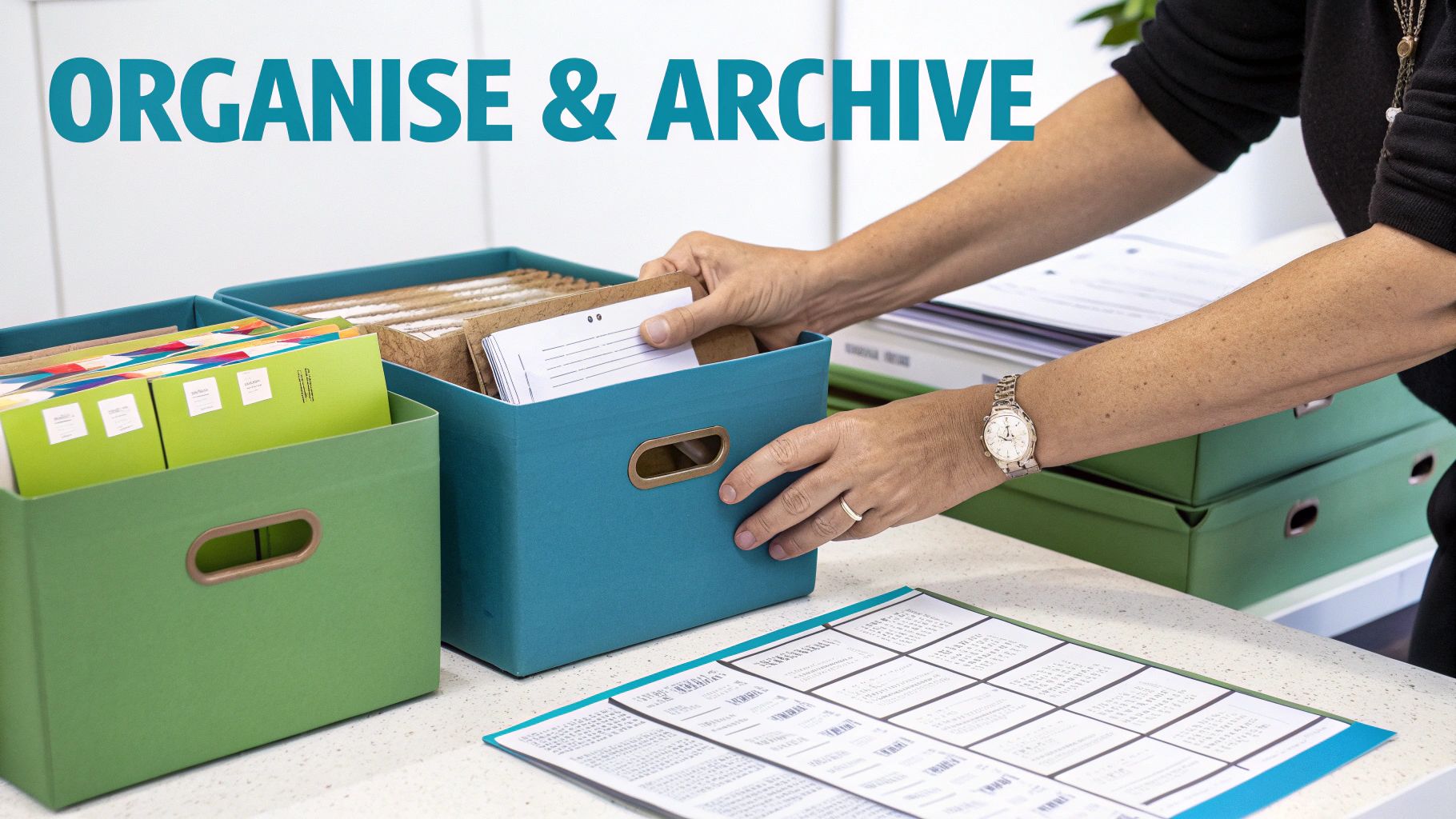
The first step is always the most important: the sort. Start by gathering every document and splitting them into broad, logical piles. Think in terms of departments (like Finance, HR, or Legal) or by document type (Invoices, Contracts, Client Records). This initial pass gives you a clear picture of what you’re dealing with.
While you’re sorting, it’s time to be ruthless with your document retention policy. Weed out and securely shred anything that’s past its legal retention date. This isn't just about reducing the volume you need to store—it’s a critical step for compliance.
Packing and Labelling Best Practices
Once your documents are sorted and purged, it’s time to pack them up for long-term safekeeping. Just chucking them into any old box is asking for trouble later. Proper packing is non-negotiable if you want to protect your files.
Here are a few essential tips:
- Use Acid-Free Archive Boxes: Standard cardboard boxes are full of acids that leach into paper over time, making it yellow and brittle. Always use purpose-built, acid-free archive boxes to guarantee your documents will last.
- Don’t Overfill: Jamming boxes to the brim makes it impossible to pull a file out later. Leave a little bit of room, but not so much that files slump over and get bent out of shape.
- Create a Clear Labelling System: Every single box needs a clear, consistent label. It should include the department, document type, date range (e.g., "Invoices 2020-2021"), and a unique box number. This label is your map.
A consistent labelling system is the backbone of any good archive. It needs to be so simple that someone completely new to your organisation could understand it at a glance.
Creating a Master Inventory List
As you pack and label each box, you need to be building a master inventory list or an index. Think of this as the detailed map to your archival treasure. This list, usually just a simple spreadsheet, is arguably the most important document in your entire archiving system.
Your master inventory is the searchable brain of your physical archive. Without it, you just have a collection of boxes; with it, you have an organised, retrievable library of information.
For every entry on your list, you should log the unique box number, its exact location in the storage unit, a detailed description of what's inside, and its scheduled destruction date. When you need to find a specific file years from now, you won't be digging through dozens of boxes—you’ll be searching this digital list.
This methodical approach ensures you can pinpoint any document in minutes, making your secure documents storage solution both safe and incredibly efficient.
Choosing Your Secure Storage Partner in The Wirral
All the theory in the world about secure documents storage boils down to a single, critical decision: picking the right local partner. For any business or individual in The Wirral and Merseyside, checking out a local self-storage provider is the final, most important step. It’s about looking past the price list and really digging into the details of their security, how easy it is to access your things, and what their reputation is like on the ground.
Making a choice you feel good about means asking the right questions. Does the facility have proper 24/7 CCTV, or just a dummy camera pointed at the gate? Can you get to your documents when you actually need them, or are you stuck with restrictive office hours? And what are real, local customers saying about their experiences?
What to Look for in a Local Facility
When you go and inspect a potential storage partner, you’re basically auditing their ability to protect your most sensitive information. A top-notch facility should have no problem showing you exactly how they keep things safe with tangible, working features.
Look for these non-negotiables:
- Modern Security Infrastructure: This means high-definition CCTV that covers every angle—all access points and corridors, not just the entrance. Secure, personalised keypad entry is also a must-have, as it guarantees only authorised clients can get inside.
- Flexible and Convenient Access: Your documents should be on your schedule, not the facility's. A provider with extended access hours, say from early morning to late evening, offers the kind of flexibility that modern work demands.
- Transparent and Fair Contracts: Steer clear of providers who try to lock you into long, rigid contracts. A trustworthy partner will offer simple rolling monthly agreements, letting you scale your storage space up or down as your needs change.
Shield Self Storage: A Wirral Case Study
To see these principles in action, you don't have to look far. At Shield Self Storage in Bromborough, we’ve built our facility to go above and beyond the standards for secure documents storage, giving Wirral businesses a clear example of what they should expect. Our site is kitted out with 24/7 monitored CCTV and a secure keypad entry system, creating a multi-layered security net.
We get that accessibility is everything, which is why our clients can access their units from 7 am to 11 pm daily. That kind of flexibility is a game-changer for businesses managing active archives. On top of that, we offer a huge range of unit sizes perfect for document boxes, all on simple, rolling contracts with no hidden fees. It’s an approach that has helped countless local companies streamline how they work, a trend you can read more about in our article on why Wirral businesses choose commercial storage.
By combining robust security, flexible access, and clear, fair terms, a local storage partner becomes more than just a space—it becomes an extension of your business's compliance and operational strategy.
Choosing a local partner also means you can physically visit the site, see the security features with your own eyes, and have a proper chat with the team. That local connection provides a level of trust and reassurance that’s essential when you’re safeguarding your most critical documents.
Frequently Asked Questions
Once you’ve started thinking about secure document storage, a few final questions usually pop up. Here are some clear, straightforward answers to the queries we hear most often from businesses and individuals, helping you tie up any loose ends.
How Long Must I Legally Keep Business Documents in the UK?
This is a big one, and the answer isn't always simple. UK document retention periods vary quite a bit depending on what the record is. As a rule of thumb, HMRC requires limited companies to keep financial and accounting records for six years after the end of the last company financial year.
But don't stop there. That six-year rule is just a baseline. Things like employee health and safety records, legal agreements, or certain insurance policies often need to be kept for much longer—sometimes even decades. The best approach is to create a formal document retention policy, ideally with legal advice, that’s tailored to your specific industry. That’s the only way to be sure you’re fully compliant.
Is It More Secure to Store Documents Physically or Digitally?
Both physical and digital storage can be incredibly secure, as long as you do it right. The "best" choice really comes down to your business and what you need in terms of access, compliance, and the types of documents you're handling.
Often, the strongest security strategy is a hybrid one. You keep the essential original documents in a professional physical storage facility while using digitised copies for day-to-day work. It’s the perfect blend of rock-solid physical security and modern convenience.
Professional physical storage is fantastic at protecting against real-world threats like fire, flooding, and break-ins, using features like climate control and advanced surveillance. On the flip side, secure digital storage is all about preventing data breaches with tools like end-to-end encryption and multi-factor authentication, with the huge advantage of remote access.
What Is the First Step in a Document Archiving Project?
Before you even think about buying a box or firing up a scanner, the most important first step is a thorough document audit. You absolutely have to get a clear picture of what you've got.
This means sorting all your documents into logical piles (think financial, HR, legal, client files) and then applying your retention policy to each category. This initial clear-out lets you securely destroy anything that’s outdated or redundant. Not only is this a crucial step for compliance, but it also dramatically shrinks the amount you need to store, making the whole project cheaper and far more manageable from day one.
Ready to put a secure, flexible, and affordable storage strategy in place for your documents? At Shield Self Storage, we offer top-tier security and easy access for businesses and residents across The Wirral. Explore our secure storage units today.